
Qualicum Institute Directors
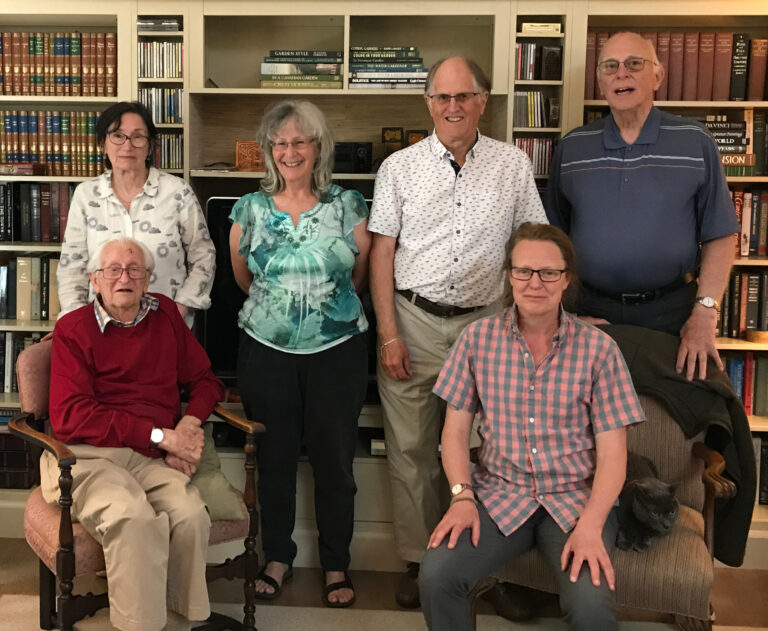
Seated, left to right: Gerry Addy, Terri Martin. Not present: Alan Hawryzki.
Qualicum Institute Director's Biographies
The Qualicum Institute was established in 2002. Its directors are concerned professionals from the fields of biology, chemical engineering, and education at the university, college, school and local government and community levels. The mission of the Qualicum Institute is to help establish ecologically, socially and economically sustainable communities that operate within the regenerative and assimilative capacity of the ecosphere.
Neil K. Dawe, Vice-President
Neil is a Retired Wildlife Biologist in British Columbia. He retired from the Canadian Wildlife Service, Environment Canada, in 2006 after 31 years in civil service on Vancouver Island, managing National Wildlife Areas and Migratory Bird Sanctuaries and working to protect migratory birds and their habitat.
Concerned about the plight of the Brant sea goose, Neil co-founded the Brant Wildlife Festival and co-chaired the festival for its first five years. This led, in part, to the establishment of the Parksville-Qualicum Beach Wildlife Management Area in 1993, which protected all Brant habitat along a 17-kilometre stretch of the Vancouver Island coast from Craig Bay north to the Little Qualicum River estuary.
In 1997, he was appointed to a two-year term as a volunteer member of the Healthy Community Advisory Commission for the City of Parksville, British Columbia. He is a founding Director of the Mount Arrowsmith Biosphere Reserve Foundation and the Qualicum Institute and was the first Canadian Director of the Center for the Advancement of the Steady State Economy (CASSE).
Neil is a recipient of Environment Canada’s Regional Citation of Excellence Award for his work in promoting the value of wildlife to Canadians and for his work with the Brant Wildlife Festival. He is also the recipient of the Federation of British Columbia Naturalist’s Outstanding Service Award.
In 2001, he was honoured with the Ian McTaggart-Cowan Award of Excellence in Biology from the Association of Professional Biologists of British Columbia “in recognition of a significant contribution to the biological sciences in British Columbia.”
Much of his work over the past 20 years has involved studies on bird use of estuaries and the restoration and creation of estuarine marsh habitat. His primary interests today, focus on the two limiting factors affecting biodiversity conservation on the Earth today: human population growth and per capita consumption.
Neil has written over 80 scientific, technical, and popular papers and articles on birds, ecology, and the environment. He is a co-author of the four-volume work, The Birds of British Columbia. He also authored the children’s book, The Hummingbird Book and Feeders and is a co-author of another popular children’s book, The Bird Book and Bird Feeder.
Susan R. Fisher, PhD., Secretary
Susan is a retired literature professor and university administrator. The author of many articles on Canadian and world literature, she received the Canada Prize in the Humanities for her 2011 book Boys and Girls in No Man’s Land: Canadian Children and the First World War. Once a climber and now a hiker, Susan compiled In the Western Mountains, an oral history of mountaineering in BC. In retirement, she has been able to devote more time to learning about the human and natural history of our region.
Neither a biologist nor an ecologist by training, Susan nonetheless feels that all citizens need to inform themselves about the complex interactions between human culture and natural systems. The most important duty we have is to become good ancestors (to borrow the title of David Ehrenfeld’s book) and to pass on to our descendants a world that has not been irretrievably damaged by human consumption. To do that in the face of declining biodiversity and human-induced climate change will require not just modifying behaviour at the individual level (important though that is); it will require a hard-to-imagine overturning of many established values and practices. The critic Fredric Jameson wrote in 2003 that “Someone once said that it is easier to imagine the end of the world than to imagine the end of capitalism.” Not wanting the first fate, Susan is looking for ways to accomplish the second—that is, to turn away from the addiction to economic growth and thus look after and if possible restore our world. Susan joined the Qualicum Institute because of its focus on the destructive effects of economic growth and the consequent need to re-think how we live.
Richard (Dick) Hampton, B. Eng. (Chem), Treasurer
After graduating in Chemical Engineering from McGill, Dick spent most of his career working in the food industry. His work included positions in Research and Development, process design, and general management. Several side ventures included: management consulting with emphasis on strategic planning, franchise restaurant operation, and even farming.
After retirement he moved to Parksville where he has been active in community affairs.
Since reading the original book, The Limits to Growth back in 1972, Dick has taken an interest in the sustainability of human civilization. He believes that now is the time for widespread action to tame humanity’s obsession with growth. It’s for the sake of our grandchildren
Terri Martin, BSc, RPBio., (ret.), President
“Rather late, the people grew alarmed.” From “The Mysteries” by Bill Watterson and John Kascht
Terri retired from his position as Environmental Specialist with the City of Campbell River after 17 years of service. His work focused on policy and bylaw development, land-use planning and development review, and aligning all aspects of City operations and long-range planning with environmental best practices and regulations. During his time in local government, he earned certificates in Local Government Administration (Capilano University, Merit List) and Ecological Restoration Professional Specialization (University of Victoria).
His career began with a Bachelor of Science from the University of Guelph, followed by work as a naturalist—first with the Capital Regional Parks system in Victoria, and later at Rathtrevor Beach Provincial Park in Parksville. He soon joined the Arrowsmith Naturalists, where he served as club president for one year. The Club recognized his invaluable contribution to its growth on their 35th anniversary.
Terri achieved the designation of Registered Professional Biologist in British Columbia in 1999. He has over 30 years of biological experience on Vancouver Island and has written numerous scientific and technical reports, popular articles, and essays. He has also provided expert witness testimony for the Conservation Officer Service and Crown Counsel.
He feels particularly grateful for having had the opportunity to work on two long-term projects on southeast Vancouver Island prior to entering civil service: tracking the spring migration of the Brant sea goose and, as program biologist on Vancouver Island, documenting and monitoring more than 1,000 Bald Eagle nest trees. The BC Ministry of Environment recognized him for his commitment to British Columbia’s natural heritage through the Wildlife Tree Stewardship Program.
Throughout much of his career, however, Terri has grown increasingly concerned that conventional conservation techniques are not working. Year after year, more habitat and biodiversity give way to human encroachment despite conservationists’ best efforts. It is this pursuit of the root causes of biodiversity loss that brought him to the Qualicum Institute.
Luisa Richardson, MSc, M.Eco Ed.
“The climate crisis has been framed as an environmental problem. That it is about atmospheric CO2, and so has us looking up for solutions, instead of looking down at the economy and exploitation of land, labour and living systems.” Gopal Dayaneni, co-founder of the Movement Generation.
After earning a B.Sc. and M.Sc. in Biology and following a 22-year career in industry, Luisa found her calling as an environmental educator, creating and delivering innovative and effective programs on behalf of local and regional governments. As a contract project manager, Luisa incorporated solid research into the scientific principles, ecology, history and government regulations underlying the topics of waste and ecological footprint reduction, water conservation and drinking watershed protection. Her research was then translated into multi-faceted and engaging education programs for the community at large and for all school grades. She hired and mentored university students to deliver the programs over many summers.
Her use of community-based social marketing techniques measurably increased public awareness and achieved the target improvements in community use of government-managed resources. She received City of Campbell River Stewardship awards in 2009 and 2014 for community engagement and outreach. Despite experiencing success, Luisa felt she should update her knowledge and credentials and completed a Masters in Eco Ed and Curriculum Development at Simon Fraser University. This together with her participation in a team that helped the BC Ministry of Education re-write the science curriculum to include ecological literacy and place-based knowledge enriched her education programs, transforming them into even more powerful agents of change.
Luisa enjoyed her “work” as an engaging facilitator, storyteller and experienced naturalist. As a Campbell River Museum history boat cruises guide, she spun the powerful geological, natural history, cultural and European currents that have swept through this area into fascinating experiences for her guests.
Her ProD workshops for teachers modeled how to incorporate the local ecology into the curriculum, while remaining respectful and ethical when observing nature around the schools.
As a life-long learner with a passion for nature, cultures and people, Luisa joined the Qualicum Institute hoping to learn how to balance our ecology with our economy and how to stem the biodiversity losses, extinctions and climate emergencies brought about by the human species.
In Memoriam
Gerry Addy, BA., B.Ed.
We are sad to announce that our friend and colleague Gerry died in the spring of this year (2025). He was 99 years old. A retired elementary school principal, Gerry was a life-long learner and tireless volunteer. Considerable research and study on climate change convinced him of the need for action, and so he became involved with the Qualicum Institute. As a director, he contributed articles, hosted meetings, and helped us believe that our efforts would lead to real change.
Allan R. Hawryzki, M.Sc.
We are sad to announce that another dear friend and colleague, Allan, also passed away in the late spring of 2025 at the age of 77. A retired university professor of biology, he completed his Master of Science as a mature student in 2003. Allan was deeply dedicated to the study and protection of wildlife on Vancouver Island, and his intellectual curiosity led him to the Qualicum Institute, where his years of study and experience were greatly valued in his role as a director.